
25 Years of Madawaska Valley
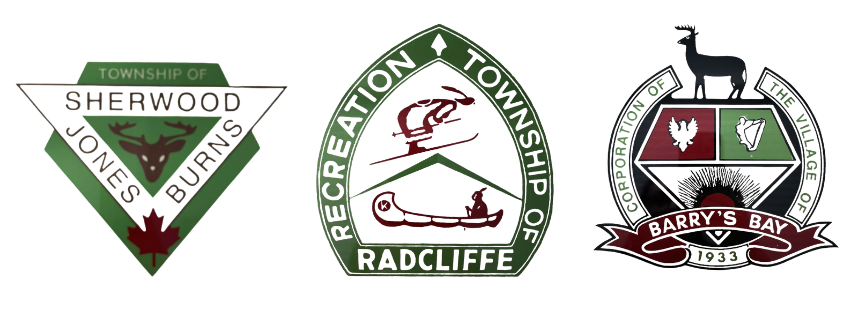
In 2001, the Township of Radcliffe, the Township of Sherwood, Jones, and Burns, and the Village of Barry’s Bay amalgamated to form the Township of Madawaska Valley.
Historical Timeline
In celebration of 25 years of Madawaska Valley, we’ll be sharing photos and stories going all the way back to the first meeting of Radcliffe Township in 1902. Visit this page regularly for updates.

1902
On January 13, 1902, the Township of Radcliffe held their first meeting with John Hudson serving as Reeve. Radcliffe had existed in some form prior to this date – the Townships of Brudenell, Radcliffe, Raglan, and Lyndoch had been incorporated back in 1860. Radcliffe gained its independence in 1902, with Mr. Hudson as Reeve and William Boehme, James McKay, Thomas Mahon, and Joseph Mayhew serving as Councillors. Treasurer W.E. James and Clerk J.E.H. Miller rounded out the table.

1903
Only a year after the creation of the Township of Radcliffe, William Boehme is elected Reeve of Radcliffe. A tailer by trade, Boehme’s name may be recognizable to those who have researched the history of the Mayflower – Boehme was a passenger on the steamer when it sunk in 1912.

1904
Meanwhile in Barry’s Bay, a new kind of industry came to town. Down Paugh Lake Road, Canada Turpentine Company Limited established a factory to extract tar and gum from tree stumps left behind from logging activities. At the time the largest industrial investment in Barry’s Bay, the factory employed thirty by 1907. Unfortunately the industry was short lived and the factory closed in July 1908. The site of the old factory changed hands a few times before being purchased by the Murray Brothers Lumber Company, who built a grading and planning facility on the land. After 33 years in operation, the machinery and equipment was moved to Madawaska.

1905
While Barry’s Bay was seeing the growth of infrastructure, Combermere had an integral piece of theirs damaged – the Combermere Bridge, then a wooden structure, collapsed from the weight of a milk delivery, coming by horse and carriage. The bridge was repaired and eventually a steel swing bridge was put in its place.

1906
Meanwhile, more turnover in the Reeve’s chair in Radcliffe: in 1906, John Hudson was once again elected into this office.

1908
In Barry’s Bay, 1908 was the year John Omanique purchased the Morrison & Gwynn Lumber Company on Kamaniskeg. In 1912, the mill was renamed the Murray & Omanique Lumber Co when Thomas and Michael Murray joined the business. While it changed hands and had different names in the decades to follow, a mill ran on the lakeshore until about 1965, at one point holding the title of largest sawmill in Renfrew County and switching from circular saw to bandsaw to cut logs for J.R. Booth. Today, you can walk the Omanique Trail from the Mask Island Causeway to the Barry’s Bay Boat Launch.

1909
Tragedy struck one evening in August 1909, when a trail derailed at Carson Lake. A washout caused portions of the track to fall into Carson Lake, and the engine, tender, and six cars rolled down an embankment. W.J. Thurston of Madawaska was the lone death in this accident at only twenty years old. In 2024, the Carson Trout Lepine & Greenan Lakes Association spent time investigating the derailment, and despite performing a dive could not find the wreckage. The organization erected a plaque at the site of the derailment and invited Thurston’s family to participate in an event in his honour.

1910

1911

1912
1912 marked the sinking of the paddlewheel steamer Mayflower, which was used for freight, mail, and limited passenger service between Combermere and Barry’s Bay starting in 1904. On the evening of Tuesday November 12, the Mayflower left Barry’s Bay around 7pm and headed for Combermere with twelve souls onboard. A storm struck midway through the trip - the boat took on water suddenly and sunk quickly. Eight lives were lost in the sinking: the entire crew, as well as five passengers. Four other passengers managed to make it to a nearby island about 600 feet away, where one more succumbed to hypothermia. The survivors were rescued the next day and the Mayflower remains a popular diving site, as portions of the boat still remain at the bottom of Kamaniskeg.

1912
Also in 1912, Radcliffe saw a new Reeve – John Cole served just one year from 1912-1913.

1913
In Wilno, the historic Wilno Tavern, then the Exchange Hotel, changed hands in 1913. Frank Shulist and Catherine Prince were the proud new owners of the establishment, who purchased it for just over $10,000. The building itself had been around since the late 1870s, when it was built to serve those travelling on the railway across the road. It was given the name Exchange Hotel in the early 1900s when it was purchased by Angus Slominski, who ran it until 1913 when it was sold to Shulist and Prince. The hotel offered room and board, had two separate beverage rooms, and at one point was even home to a bank and barber. The building was renamed Wilno Public House in 1975, and then to Wilno Tavern in 1979 when it operated strictly as a bar. In 1990, the dining room reopened and expanded and has been operating as a restaurant ever since.

1914
In 1914, Charles B Dennison was elected as Reeve in Radcliffe, and also served as Warden of Renfrew County. The longest serving Reeve in Radcliffe’s history, Reeve Dennison held the post from 1914 to 1930.

1915
In 1915, John O’Manique is elected Reeve of Sherwood, Jones and Burns. Yes – the same John O’Manique who owned the lumber mill on Kamaniskeg around the same time.

1918
A few years later in 1918, a well-known institution in Combermere had a new owner. Archie Kernocha took over ownership of Valley Market General Store in this year and ran it until 1925, but he was the fourth owner of the store that had been in operation since 1859. It has had many names over the years, and in 2009 the store celebrated 150 years of continuous operation. This historical landmark in Combermere’s core still operates today jointly as Bent Bud and Bent Pizza.

1919
In 1919, there was a new face in the Reeve chair in Sherwood Jones and Burns: Michael Conlin.

1920
Conlin served just one year, with Philip Blank elected in 1920.

1921
In 1921, SS#1 Radcliffe opened in Halfway, a school that allowed students to be educated closer to home. Before it opened, on land donated by Paul Smaglinskie, students further afield or studied at home. Halfway at the time was bustling, with the schoolhouse complimented by a stopping place or hotel, stables and barns, and later gas pumps and a restaurant.

1922

1923
In 1923, the railway serving Barry’s Bay and Wilno was purchased by the Canadian National Railway. Originally owned by J.R. Booth’s Ottawa Arnprior and Parry Sound Railway System, trains began coming through out area in 1894 and resulted in massive growth throughout the region. The last scheduled trains came through in the early 1960s, though trains still used the tracks until the mid 1970s. Today, the track is a popular recreational trail and you can still visit Barry’s Bay’s original railway station in the heart of town.

1924
In 1924, more action in Sherwood Jones and Burns council as Thomas Murray becomes Reeve. After serving our on municipal council, he moved on to provincial politics, first elected in 1929 as Member of Provincial Parliament for Renfrew South and re-elected three times: 1934, 1937, and 1943, before being defeated in the 1945 election and returning home. He died in October 1981 at the age of 101. Politics runs in the family: his grandson Sean Conway also served as MPP or our region from 1975-2003.

1930
1930 saw political change across our communities.
In Sherwood Jones and Burns, Paul Mask is elected as Reeve. Mask will be a familiar name to many – it is he who Mask Island is named for, and he was the first owner of the Barry’s Bay Dairy. More on that in a few years though!

1930
Over in Radcliffe, Fred Schweig is elected Reeve.

1933
In 1933, the Town of Barry’s Bay is officially incorporated with Henry Chapeskie serving as its first Mayor. Barry’s Bay itself is a bit older: home to Indigenous peoples since time immemorial, the creation of the Opeongo Line brought the first European settlers, and the railway increased the population and growth dramatically. The town incorporated in 1933 comprised of 520 acres formally of the Township of Sherwood.

1930

1930
Tragedy struck Wilno in 1937, as Flora’s General Store burned to the ground due to a faulty chimney. The entire store, as well as the blacksmith shop next door, was lost. The Exchange Hotel (now Wilno Tavern) was also damaged in the blaze. Flora Blank was undeterred – she’d been running the store since 1933 in her late husband’s office, selling groceries and ice cream and was no stranger to hardship. After the fire, she built a new store that same year, which grew to sell everything from dry goods, footwear, hardware, and gas. The store was taken over by Flora’s daughter in 1953, and changed hands a number of times before closing its doors in the mid 2010s. The building that exists today is the same one Flora and her husband Felix Lazinskie built after the fire. Flora died in 1989 at the age of 85.

1938
1938 was also a year for business in Barry’s Bay: Paul Mask opens his dairy this year, where the old Barry’s Bay Dairy Bar still is today. Mask purchased the lot for $175 and built a plant to pasteurize milk from his cows on Mask Island. The raw milk was delivered by family members to the plant to be processed, where it was then delivered to houses and stores in the community by horse and cart. The Masks sold the dairy in 1945 but continued to supply milk to the new owners.

1939
1939 saw the continued growth of infrastructure in Barry’s Bay: the new post office opened this year in its current location. A grant of $15,000 was provided for the build. Barry’s Bay has had post offices since 1877, but they had always run out of private homes or businesses.

1940
The following year, the Church of the Assumption of the Blessed Virgin Mary burns down. The church, located at Siberia and Kartuzy roads, was built in 1896 to serve families living down Siberia Road. Previously, they had walked or drove with horses to Brudenell or Wilno to attend church services. The Church served parishioners until just 1914 and was empty when it burned down in 1940. The graveyard and stone foundation still exists today.

1941
John Hudson is back as Reeve in Radcliffe in 1941, serving the final of his three terms from 1941-1943.

1943
In 1943, Patrick Fitzgerald becomes Reeve of Radcliffe. Pat Fitzgerald had previously owned a few businesses in town, including a gas station and a general store.

1944
In July of 1944, local lad Frank Yaraskovitch was captured by German forces during the Battle for Verrieres Ridge in France. Born and raised in Halfway, Frank was one of many from the area who enlisted during World War II, and pictured here are his papers from when he was registered as a Prisoner of War at just 23 years old. After his capture, Frank was relocated by train to a prisoner camp in Germany and was able to send letters to his sister back home to let her know he was well. In 1945, after being forced to march several hundred kilometres as the war drew to an end, Frank was freed and made his way back to England before returning home. Frank spent his later years in Chalk River raising a family and working for Atomic Energy of Canada before passing away in 2006 at the age of 85.

1946
More turnover in the Reeve’s chair in Radcliffe: in 1946, Tony Golka becomes Reeve for just one year, but will serve again from 1948-1954.

1947
In 1947, Horace Landon is elected Mayor of Barry’s Bay, after working at the Township Offices as the first village clerk in 1933. Previously, Landon had worked at the Barry’s Bay Railway Station as an Operator.

1947
Also in 1947, Henry Drevniok serves as Reeve of Radcliffe.

1949
In 1949, John Lapenskie is elected Reeve of Sherwood Jones and Burns.

1950
In 1950, indoor skating came to Barry’s Bay for the first time as The Old Grey Lady…I mean, the Township of Sherwood Jones and Burns Community Centre, opens. It was dismantled in 1980 once the Sherwood Bay Arena (now Paul J Yakabuski Community Centre) opened on Arena Road, but in those thirty years was the best place to catch a game or attend a local dance.

1950
In 1950, Henry Chapeskie is elected Reeve of Sherwood Jones and Burns. After his political career, he played an important role in the early years of St. Francis Memorial Hospital.

1951
In 1951, some more turnover in SJB: Murray Daly is elected Reeve and would hold the position for nine years until 1960. Daly was instrumental in the building of Barry’s Bay’s first indoor rink, and after his time in politics he went on to serve as Board Chairman at Madawaska Valley District High School.

1953
In 1953, Paul Yakabuski was elected Mayor of Barry’s Bay. He served until 1961, when he made the jump to provincial politics and became a Member of Provincial Parliament for Renfrew South in 1963, serving until 1987 when he retired.

~1954
In the mid 1950s, change came to Barry’s Bay in the form of diesel trains. The final steam train came through around this time, and all future trains relied on diesel, marking the end of the use of the Barry’s Bay Water Tower. The tower, built in 1894 and dismantled and relocated in 1943, fell into a state of disrepair once it was no longer in use by coming trains.

1955
In 1955 in Radcliffe, Joseph Peplinskie is elected Reeve. He would serve over ten years until 1966. His son followed in his footsteps – the late Ernie Peplinskie served as a Councillor in Radcliffe and Madawaska Valley.

1959
In 1959, also in Combermere, the old steel and wooden bridge was replaced with a modern sloped and curved bridge, the first of its kind in the province. The previous bridge was dismantled in 1960 after construction on the new bridge was completed – the inset photo shows the side-by-side bridges.

1960
The official ribbon cutting for St Francis Memorial Hospital was in October 1960, with new patients being admitted starting December 1. Spearheaded by the late Reverend Peter Biernacki of St Hedwigs, the lands for the hospital were purchased in 1947, and the Charter for the hospital was given in 1952. A sod turning ceremony took place in August 1959 and the $445,000 hospital took about ten months to be built. The hospital allowed for care closer to home – prior to its opening, the closest hospitals were in Renfrew, Pembroke, and Bancroft.

1961
Another ribbon was cut the next year – in 1961, the Madawaska Valley Public Library opened its doors in the municipal office. The demand for library services increased over the years, and in 1967 the Town of Barry’s Bay purchased the Bell Telephone Building to serve as the new library, opening its doors in April 1968. In 1986, the building was extended to include the back wing. The Library continues to enjoy demand for services, which has changed dramatically from 1961 – not only does the library have books, periodicals, and other printed materials but internet access, DVDs, e-books and the popular interlibrary loan service.

1961
In 1961, Felix Pecarskie is elected Reeve of Sherwood Jones and Burns.

1962
Just a year after Felix Pecarskie is elected Reeve of Sherwood Jones and Burns, Don Ellis takes over the position.

1962
More politics! In Barry’s Bay in 1962, Thomas Conway is elected Mayor.

1963
In 1963, Ronald Briggs takes over the Reeve position in Sherwood Jones and Burns.

1967
1967 was a big year for the region – Madawaska Valley District School officially opened its doors. Serving an area of 180 square kilometres, the school was built to accommodate 840 students. In 2016, the school became home to Sherwood Public School, with B wing being redesigned for the elementary students and science room shuffling to C wing. The school changed its name and consolidated to one school in 2024, now known as Madawaska Valley District School. Next year, the school will celebrate its 60th anniversary.

1967
On the political side, Hilary Jones is elected Mayor of Barry’s Bay that same year.

1967
Nicholas Lepinskie is elected Reeve of Radcliffe in 1967. Mr Lepinskie also served as Warden for Renfrew County during his tenure as Reeve.

1968
In 1968, the C.F. Cannon School in Combermere closes. The school was built in 1953 and at its peak had 75 students of all grades. The school building still stands at the corner of Highway 62 and Meadowlark Road. George Vanier Catholic School opened the following year to continue to serve the schooling needs of the community.

1969
In 1969, Martin Shulist is elected Reeve of Sherwood Jones and Burns. He would serve again in 1977.

1970
In 1970, Mount Madawaska opens. Located on Highway 62 between Combermere and Barry’s Bay, and also known at one point as Radcliffe Hills, the small ski hill thrived with multiple runs, a bunny hill, tubing hill, pro shop and a vertical drop of 450 feet – one of the largest in Ontario. The facility closed permanently over ten years ago and is now privately owned.

1971
In 1971, the Township of Radcliffe purchased its first fire truck and the Radcliffe Fire Department was formed with a first-year budget of $7,717. Allen Shulist served as Chief and Bob Coulas as Deputy Chief.

1973
In 1973, Christopher Mullin was elected Reeve of Sherwood Jones and Burns.

1973
In 1973, the Barry’s Bay Legion opened its new building at its current location. The Legion itself is a bit older, having been formed on May 28 1946. The Legion purchased a house on the corner of Bay and Inglis streets before working on a plan for a larger hall. A sod turning ceremony took place in 1972 and after countless volunteer hours and private monetary donations, the hall held a grand opening in May of 1973. The new facility held a club room, banquet hall, and kitchen and has since been the host of countless private and public events. Join them on October 19 to elect their next president and continue their tradition of serving the community.

1973
Also in 1973, Crooked Slide Park opens in Combermere. During the lumber days, the waterway at the park was used to float timber cut in Richards Township into the mighty Madawaska River. When logs kept getting jammed at one particular part along Byers Creek, a log slide was built. A control dam was also constructed to divert water into the chute. Eventually, the chute went into disuse and it was not until the early 1970s that the Township of Radcliffe recreated the chute with grant funding. The land was donated by the Murray Bros Lumber Company, and the park quickly became a popular destination and picnic spot. The chute was restored again in 1994 and is currently undergoing significant rehabilitation.
Special thanks to the below organizations and groups from which the above information was compiled:
- Combermere Heritage Society
- Wilno Heritage Society
- Stationkeepers MV
- Madawaska Valley Public Library
- Madawaska Valley Heritage Walks
- Carson Trout Lepine & Greenan Lakes Association
Did we get a fact wrong? Please let us know: contact us by email or 613-756-2747 x220.
Sign up to our News & Notices
Stay up to date on the Township's activities, events, programs and operations by subscribing to our News & Notices