
25 Years of Madawaska Valley
In 2001, the Township of Radcliffe, the Township of Sherwood, Jones, and Burns, and the Village of Barry’s Bay amalgamated to form the Township of Madawaska Valley.
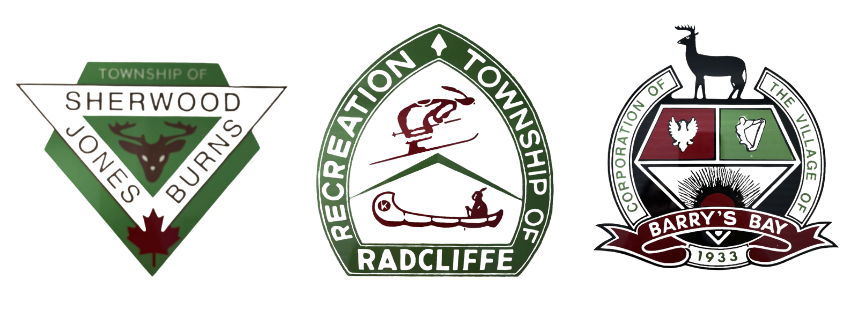
In celebration of 25 years of Madawaska Valley, we’ll be sharing photos and stories going all the way back to the first meeting of Radcliffe Township in 1902. Visit this page regularly for updates.

1902
On January 13, 1902, the Township of Radcliffe held their first meeting with John Hudson serving as Reeve. Radcliffe had existed in some form prior to this date – the Townships of Brudenell, Radcliffe, Raglan, and Lyndoch had been incorporated back in 1860. Radcliffe gained its independence in 1902, with Mr. Hudson as Reeve and William Boehme, James McKay, Thomas Mahon, and Joseph Mayhew serving as Councillors. Treasurer W.E. James and Clerk J.E.H. Miller rounded out the table.

1903
Only a year after the creation of the Township of Radcliffe, William Boehme is elected Reeve of Radcliffe. A tailer by trade, Boehme’s name may be recognizable to those who have researched the history of the Mayflower – Boehme was a passenger on the steamer when it sunk in 1912.

1904
Meanwhile in Barry’s Bay, a new kind of industry came to town. Down Paugh Lake Road, Canada Turpentine Company Limited established a factory to extract tar and gum from tree stumps left behind from logging activities. At the time the largest industrial investment in Barry’s Bay, the factory employed thirty by 1907. Unfortunately the industry was short lived and the factory closed in July 1908. The site of the old factory changed hands a few times before being purchased by the Murray Brothers Lumber Company, who built a grading and planning facility on the land. After 33 years in operation, the machinery and equipment was moved to Madawaska.

1905
While Barry’s Bay was seeing the growth of infrastructure, Combermere had an integral piece of theirs damaged – the Combermere Bridge, then a wooden structure, collapsed from the weight of a milk delivery, coming by horse and carriage. The bridge was repaired and eventually a steel swing bridge was put in its place.

1906
Meanwhile, more turnover in the Reeve’s chair in Radcliffe: in 1906, John Hudson was once again elected into this office.

1908
In Barry’s Bay, 1908 was the year John Omanique purchased the Morrison & Gwynn Lumber Company on Kamaniskeg. In 1912, the mill was renamed the Murray & Omanique Lumber Co when Thomas and Michael Murray joined the business. While it changed hands and had different names in the decades to follow, a mill ran on the lakeshore until about 1965, at one point holding the title of largest sawmill in Renfrew County and switching from circular saw to bandsaw to cut logs for J.R. Booth. Today, you can walk the Omanique Trail from the Mask Island Causeway to the Barry’s Bay Boat Launch.

1909
Tragedy struck one evening in August 1909, when a trail derailed at Carson Lake. A washout caused portions of the track to fall into Carson Lake, and the engine, tender, and six cars rolled down an embankment. W.J. Thurston of Madawaska was the lone death in this accident at only twenty years old. In 2024, the Carson Trout Lepine & Greenan Lakes Association spent time investigating the derailment, and despite performing a dive could not find the wreckage. The organization erected a plaque at the site of the derailment and invited Thurston’s family to participate in an event in his honour.

1910

1911

1912
1912 marked the sinking of the paddlewheel steamer Mayflower, which was used for freight, mail, and limited passenger service between Combermere and Barry’s Bay starting in 1904. On the evening of Tuesday November 12, the Mayflower left Barry’s Bay around 7pm and headed for Combermere with twelve souls onboard. A storm struck midway through the trip - the boat took on water suddenly and sunk quickly. Eight lives were lost in the sinking: the entire crew, as well as five passengers. Four other passengers managed to make it to a nearby island about 600 feet away, where one more succumbed to hypothermia. The survivors were rescued the next day and the Mayflower remains a popular diving site, as portions of the boat still remain at the bottom of Kamaniskeg.

1912
Also in 1912, Radcliffe saw a new Reeve – John Cole served just one year from 1912-1913.

1913
In Wilno, the historic Wilno Tavern, then the Exchange Hotel, changed hands in 1913. Frank Shulist and Catherine Prince were the proud new owners of the establishment, who purchased it for just over $10,000. The building itself had been around since the late 1870s, when it was built to serve those travelling on the railway across the road. It was given the name Exchange Hotel in the early 1900s when it was purchased by Angus Slominski, who ran it until 1913 when it was sold to Shulist and Prince. The hotel offered room and board, had two separate beverage rooms, and at one point was even home to a bank and barber. The building was renamed Wilno Public House in 1975, and then to Wilno Tavern in 1979 when it operated strictly as a bar. In 1990, the dining room reopened and expanded and has been operating as a restaurant ever since.

1914
In 1914, Charles B Dennison was elected as Reeve in Radcliffe, and also served as Warden of Renfrew County. The longest serving Reeve in Radcliffe’s history, Reeve Dennison held the post from 1914 to 1930.
Special thanks to the below organizations and groups from which the above information was compiled:
- Combermere Heritage Society
- Wilno Heritage Society
- Stationkeepers MV
- Madawaska Valley Public Library
- Madawaska Valley Heritage Walks
- Carson Trout Lepine & Greenan Lakes Association
Did we get a fact wrong? Please let us know: contact us by email or 613-756-2747 x220.
Contact Us
Township of Madawaska Valley
85 Bay Street, PO Box 1000
Barry’s Bay, ON, K0J 1B0
T 613-756-2747
TF 1-866-222-8699
F 613-756-0553
Sign up to our News & Notices
Stay up to date on the Township's activities, events, programs and operations by subscribing to our News & Notices